
QUESTIONABLE SOURCE
A questionable source exhibits one or more of the following: extreme bias, consistent promotion of propaganda/conspiracies, poor or no sourcing to credible information, a complete lack of transparency, and/or is fake news. Fake News is the deliberate attempt to publish hoaxes and/or disinformation for profit or influence (Learn More). Sources listed in the Questionable Category may be untrustworthy and should be fact-checked on a per-article basis. Please note sources on this list are not considered fake news unless specifically written in the reasoning section for that source. See all Questionable sources.
- Overall, we rate Gates of Vienna as a Very Low factual, Extreme Right, Questionable blog that promotes anti-Muslim conspiracy theories, unverified claims, and hate-filled rhetoric. It lacks transparency, offers poor sourcing, and exists to amplify a singular, ideologically driven narrative hostile to Islam and immigration.
Detailed Report
Questionable Reasoning: Propaganda, Poor Sourcing, False Claims, Lack of Transparency. Conspiracy, Pseudoscience, Hate
Bias Rating: EXTREME RIGHT (9.4)
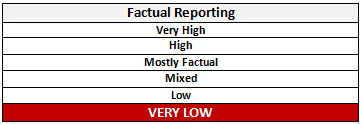
Factual Reporting: VERY LOW (9.7)
Country: USA
MBFC’s Country Freedom Rating: MOSTLY FREE
Media Type: Website
Traffic/Popularity: Minimal Traffic
MBFC Credibility Rating: LOW CREDIBILITY
History
Gates of Vienna is a pseudonymous blog launched in 2004 by the anonymous blogger Baron Bodissey (Edward S. May). Its name references the 1683 Battle of Vienna and symbolizes resistance to Islamic influence in Europe.
May is a proud Islamophobe, once declaring: “Islamophobia is a rational response to current events. If you’re not an Islamophobe, you’re not paying attention.”
The blog is based in Virginia, USA.
Read our profile on the United States government and media.
Funded by / Ownership
The site does not disclose ownership, funding, or editorial structure. Authors use pseudonyms like Baron Bodissey (the owner Edward S. May), and there is no About page, mission statement, or disclosure of organizational ties or sponsors.
Analysis / Bias
Gates of Vienna operates as an anti-Muslim conspiracy blog. It prominently features the debunked “Great Replacement” theory (e.g., “Replacement Migration in Norway”), a white nationalist narrative alleging deliberate demographic replacement by Muslims. The site also promotes “Eurabia” concepts — that Western elites are secretly surrendering to Islamic control (e.g., “The Suicide of the West”).
Sourcing is weak or non-existent. For example, articles like “Who Is the Real Enemy?” present long editorials with no external links, sources, or evidence — just ideological assertions.
The editorial tone is explicitly hostile toward Muslims, framing Islamic culture as an existential threat. See:
- “The Islamic War Machine”
- “Swedish Government to Citizens: You Are Expendable”
- “The De-Christianization of Europe”
There is also a consistent use of loaded language (e.g., “jihad invasion,” “cultural suicide,” “submission”), reinforcing the blog’s narrative without balance or critique.
Gates of Vienna generally supports Donald Trump but sometimes criticizes him for not being extreme enough with Islamic Countries.
Failed Fact Check
While the site is generally ignored by mainstream fact-checkers due to its fringe nature, it repeatedly promotes claims rejected by credible outlets:
- “Great Replacement” theory — debunked as a white nationalist conspiracy by AP and FactCheck.org
- “Sharia law spreading in Europe” — see articles like Sharia Zones in Belgium, which rely on stereotypes, not sourced legal data.
Overall, we rate Gates of Vienna as a Very Low factual, Extreme Right, Questionable blog that promotes anti-Muslim conspiracy theories, unverified claims, and hate-filled rhetoric. It lacks transparency, offers poor sourcing, and exists to amplify a singular, ideologically driven narrative hostile to Islam and immigration. (D. Van Zandt 04/10/2025)
Source: https://gatesofvienna.net/
Last Updated on April 11, 2025 by Media Bias Fact Check
Do you appreciate our work? Please consider one of the following ways to sustain us.
or
Left vs. Right Bias: How we rate the bias of media sources